

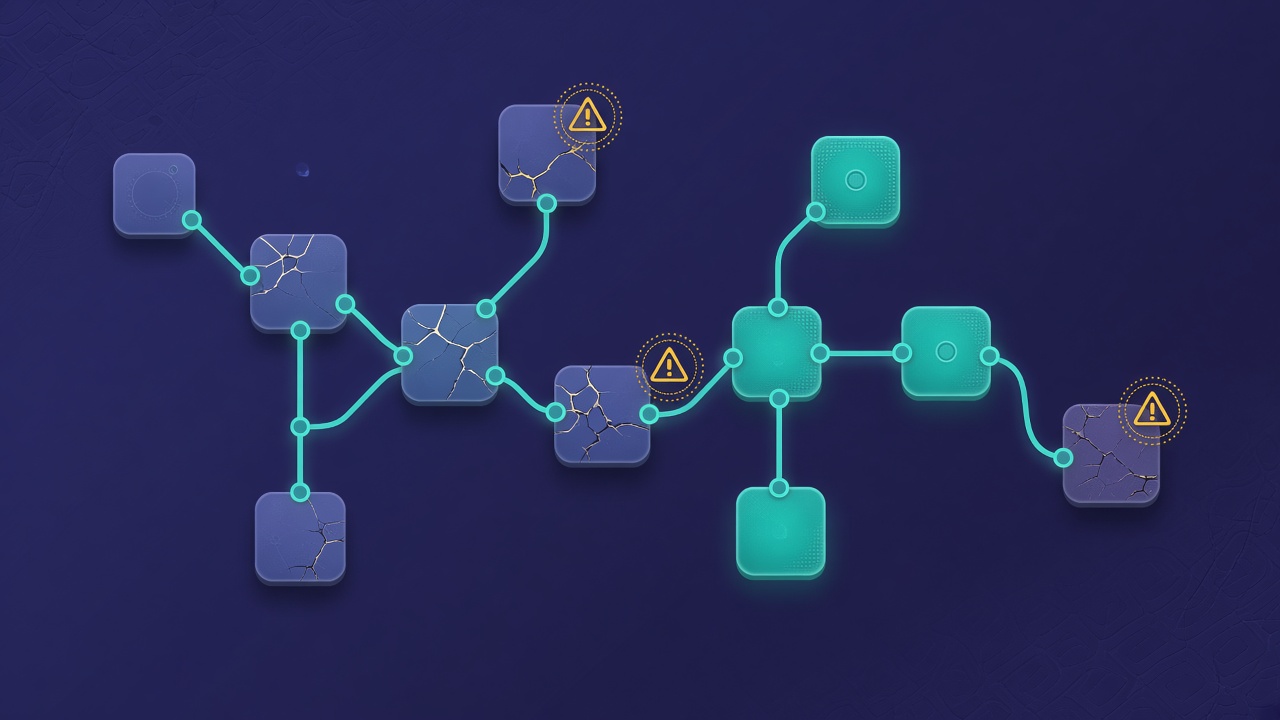
Update, 30 October 2026: the n8n 3.0 beta is out. n8n published version 3.0.0 on 27 October 2026 and 3.0.1 on 28 October as early-access (pre-release) builds, and a stable 3.x release is still planned for early December, according to n8n’s official announcement. We have also added the configuration changes n8n has since listed in its breaking-changes docs. It is a “breaking changes” release with few new features. Here is what breaks, who is affected, and how to check your own workflows before you upgrade.
What breaks in n8n 3.0?
n8n 3.0 removes legacy nodes (Function, Function Item, Item Lists, Cron, Interval, the legacy OpenAI node and AI Agent v1 modes), drops npm and npx installs in favour of Docker, tightens security defaults, and changes how a few nodes behave. Workflows that use a removed node fail until you replace it.
The full list is on n8n’s v3.0 breaking changes page. n8n explains the reason for a major version in its announcement: it follows semantic versioning, so a year of collected breaking changes ships together in one release. Most of the work, n8n says, is “under the hood”, focused on reliability, stability and security.
When is n8n 3.0 released?
The 3.0 beta shipped on schedule: n8n released 3.0.0 on 27 October 2026 and the 3.0.1 bug-fix build on 28 October, both marked as pre-releases. A stable 3.x release is planned for early December 2026. n8n Cloud users can pick “3.0.0 Beta (early access)” when changing version. No sign-up is needed.
Self-hosters, pin the version. 3.0 is published as Docker images only (there’s no 3.x package on npm). When we checked on 30 October, the moving beta and next Docker tags still pointed to 2.46.3 and latest/stable to 2.45.7, so pulling beta does not give you 3.0. To test v3, use the explicit tag, for example docker.n8n.io/n8nio/n8n:3.0.1, on a separate test instance.
| Milestone | Date (per n8n) | What it means |
|---|---|---|
| 3.0.0 beta | Released 27 October 2026 (3.0.1 on 28 Oct) | Try it on a test instance only |
| 3.x stable | Early December 2026 | New features ship on v3 only from here |
| 2.x support | 12 months after v3 stable | Security and critical bug fixes only |
One warning from n8n deserves its own line: moving to 3.x is one way. There is no going back to 2.x afterwards. If you are still on 1.x, n8n says to upgrade to v2 first, then to v3.
Which nodes does n8n 3.0 remove?
n8n 3.0 removes more than 30 legacy nodes. The ones most people will hit are Function, Function Item, Item Lists, Cron, Interval, the legacy OpenAI node, the legacy HTTP Request Tool, SerpApi and AI Agent version 1. Most have a direct replacement; a few, such as SerpApi, Zep and Orbit, don’t.
| Removed in 3.0 | Replace with |
|---|---|
| Function | Code node, “Run Once for All Items” mode |
| Function Item | Code node, “Run Once for Each Item” mode |
| Item Lists | Split Out, Aggregate, Sort, Limit (match the operation you used) |
| Cron, Interval | Schedule Trigger |
| HTML Extract | HTML node, “Extract HTML Content” operation |
| Read PDF | Extract from File, “Extract From PDF” |
| Read/Write Binary File(s) | Read/Write Files from Disk |
| Workflow Trigger | n8n Trigger |
| OpenAI (legacy), OpenAI Assistant | OpenAI node in the AI section (Assistant resource for assistants) |
| OpenAI Model | OpenAI Chat Model |
| HTTP Request Tool (legacy) | HTTP Request node on the AI Agent’s Tool input |
| Manual Chat Trigger | Chat Trigger |
| AI Agent v1 (SQL, Conversational, ReAct, Plan and Execute, OpenAI Functions) | Latest AI Agent (Tools Agent) |
| SerpApi (Google Search) | No direct replacement: call SerpApi via HTTP Request as a tool, or a verified community node |
| Motorhead, Zep memory, Zep Vector Store | No direct replacement: use another memory or vector store node |
| Orbit | No replacement (the Orbit service shut down) |
Two related changes catch people out. You can no longer add or run an AI Transform node in 3.0, and n8n does not convert them on upgrade. Migrate them to Code nodes from Settings > Migration Report before you upgrade; the migration keeps the generated JavaScript, and nodes that never generated code have to be replaced by hand. And the Edit Image node drops versions 1 and 1.1; version 2 uses a different image library, so output such as blur and text placement can change.
How common are these breaks in real workflows?
Common. A community member scanned all 13,429 public n8n templates and found that 2,284 of them, about 17%, use at least one node that 3.0 removes or changes. AI Agent v1 alone accounted for 1,493 templates, roughly two-thirds of all breaks.
The scan was posted on the n8n forum on 21 October 2026 (read the thread). The author is clear about its limits: it is a static check of workflow JSON, nothing was executed, and 1,823 templates using community nodes were marked “unknown”. The most common breaks were:
| Node | Templates affected | Replacement |
|---|---|---|
| AI Agent v1 | 1,493 | Current AI Agent (Tools Agent) |
| Function | 331 | Code node |
| Cron | 245 | Schedule Trigger |
| OpenAI (legacy) | 113 | OpenAI node (AI section) |
| HTTP Request Tool (legacy) | 95 | HTTP Request node as a tool |
The practical lesson: if you import templates from the public library or older tutorials, check them before you rely on them in 3.0.
Does n8n 3.0 still support npm installs?
No. Self-hosted n8n 3.0 requires a Docker-based deployment. n8n no longer supports installs run with npm or npx n8n, and it no longer publishes a runnable n8n package to npm. Docker Compose, Kubernetes and Helm setups are not affected by this change.
If you run n8n with npm today, n8n’s docs recommend the one-line setup, which checks Docker, writes configuration files and starts a new instance:
curl -fsSL https://get.n8n.io | shFor a team or production instance, n8n points to its Docker Compose guide, which runs n8n with Postgres. We walk through that setup in How to Self-Host n8n with Docker Compose. As always, read a script before piping it into your shell.
What security and behaviour changes come with n8n 3.0?
n8n 3.0 turns encryption key rotation on by default and requires a signing secret on Slack API credentials. Several nodes behave differently: Gmail Trigger versions 1–1.3 run as version 1.4, “Always Output Data” changes on If and Switch nodes, and the Chat Trigger’s WebSocket now sends JSON frames.
- Slack signing secret. Workflows with a Slack Trigger need the secret before you upgrade; otherwise the workflow fails to publish and the trigger responds with a 401 error. Other Slack workflows need it the next time you edit the credential.
- Encryption key rotation. On by default. Data encrypted before the upgrade stays readable. n8n’s advice: nothing to do, but back up your database first.
- Gmail Trigger below 1.4. Max Emails per Poll applies to every poll (default 10, up to 50), drafts are skipped unless you turn on Include Drafts, and sent or scheduled emails no longer trigger the workflow.
- Always Output Data on multi-output nodes such as If and Switch behaves differently; review each affected node.
- Chat Trigger WebSocket frames are now JSON objects with a
typefield. If you embed@n8n/chat, update to 1.31.0 or later first. - Expressions:
$getPairedItemis removed. Use$('node').item,.itemMatching()or.pairedItem(). - Execute Sub-workflow: the Local File and URL sources are removed; import the sub-workflow and use the Database source.
- Retired features: Chat Hub is off by default (you can turn it back on for 3.x) and Import from URL is removed from the editor.
Which configuration changes in n8n 3.0 affect self-hosters?
n8n’s breaking-changes page (checked 30 October 2026) also lists configuration changes that matter if you run your own Docker setup. The most likely to bite are the storage folder rename, unverified community nodes being turned off, and the shorter Code node timeout.
- Storage folder renamed. On first start, 3.0 renames
~/.n8n/binaryDatato~/.n8n/storage. If both folders exist, n8n refuses to start. If you mount a volume atbinaryData, mount it atstorageor setN8N_STORAGE_PATH. - Unverified community nodes off by default.
N8N_UNVERIFIED_PACKAGES_ENABLEDnow defaults tofalse, so installed unverified community nodes stop loading. Set it totrueor switch to verified nodes. - Code node timeout cut to 1 minute.
N8N_RUNNERS_TASK_TIMEOUTdrops from 300 to 60 seconds. Long-running Code node tasks fail unless you set it explicitly. - Queue mode: manual executions always run on workers and
OFFLOAD_MANUAL_EXECUTIONS_TO_WORKERSis removed, so give workers enough memory. - In-memory binary data removed.
N8N_DEFAULT_BINARY_DATA_MODE=defaultswitches tofilesystem; check disk space on the volume. - Stricter limits: the Compression node now stops at 256 MiB and 1,000 zip entries (was 2 GiB and 5,000), and the default SSRF block list adds four ranges, including carrier-grade NAT
100.64.0.0/10. - Removed variables:
N8N_PRE_EXECUTE_ERROR_CREATES_EXECUTION,N8N_DB_PING_TIMEOUT(useDB_PING_TIMEOUT_MS) andN8N_WORKFLOW_TAGS_DISABLED. The Code node also loses$evaluateExpression()(only insecure-mode task runners were affected) and the Ask AI tab.
n8n logs a deprecation warning on 2.x at startup for each of these that affects your instance, so check your container logs after updating to the latest 2.x.
How do I check my workflows before upgrading to n8n 3.0?
Use the built-in Migration Report. On n8n 2.39 or later, open Settings > Migration Report. It lists the workflows and instance settings that need attention, can fix many issues automatically, and saves each fix as a new workflow version for you to review.
n8n recommends this path, in order:
- Update to the latest 2.x version. It has the newest version of the Migration Report.
- Open Settings > Migration Report and fix, or mark as “won’t fix”, everything it flags. Admins see every workflow and can assign workflows to their owners; other users see the workflows they can access.
- Take a full backup of the database and your encryption key.
- Upgrade a test or staging instance first, run your important workflows, then upgrade production.
For templates you haven’t imported yet, the community scan’s author also built a browser-based checker at n8nready.com. It is a side project, not affiliated with n8n, and a “ready” result only means no removed nodes were found, not that the workflow will run.
What should self-hosters do this week?
If you self-host, do three things now: confirm you run n8n on Docker (not npm), update to the latest 2.x and clear the Migration Report, and set up a separate test instance for the beta. Don’t upgrade production on beta day.
A cheap way to get a test instance is a small VPS for a month. Our RAM sizing guide shows that 2 GB is enough for a test box, and the VPS comparison lists current prices. If you would rather not manage upgrades at all, compare the managed options in Zapier vs Make vs n8n: real cost.
Frequently asked questions
When is n8n 3.0 released?
The n8n 3.0.0 beta was released on 27 October 2026, followed by 3.0.1 on 28 October, as early-access builds. A stable 3.x release is planned for early December 2026, according to n8n’s official announcement. Dates can move, so follow n8n’s release notes.
Can I go back to n8n 2.x after upgrading to 3.0?
No. n8n says moving to 3.x is one way and there is no going back to 2.x afterwards. Test on a separate instance first and take a full backup of your database and encryption key before upgrading production.
Will my Function and Cron nodes still work in n8n 3.0?
No. n8n 3.0 removes the Function, Function Item, Cron and Interval nodes, and workflows that use a removed node fail. Replace Function with the Code node and Cron or Interval with the Schedule Trigger before you upgrade.
Does n8n 3.0 affect the free self-hosted version?
Yes. n8n says all v3 changes apply to everyone: the free self-hosted Community Edition, n8n Cloud and the Business and Enterprise editions. The Migration Report is available in all of them.
How long will n8n 2.x be supported?
n8n says version 2.x will keep getting security and critical bug fixes for 12 months after the v3 stable release. New features only ship on v3 from the stable release onward.
Sources
n8n Docs: v3.0 Breaking changes; n8n community: Announcing n8n version 3.0 (posted 23 October 2026); n8n community: static scan of 13,429 public templates (21 October 2026); GitHub releases 3.0.0 and 3.0.1; Docker Hub and npm tags checked 30 October 2026. This article will be updated when the stable release ships.
