

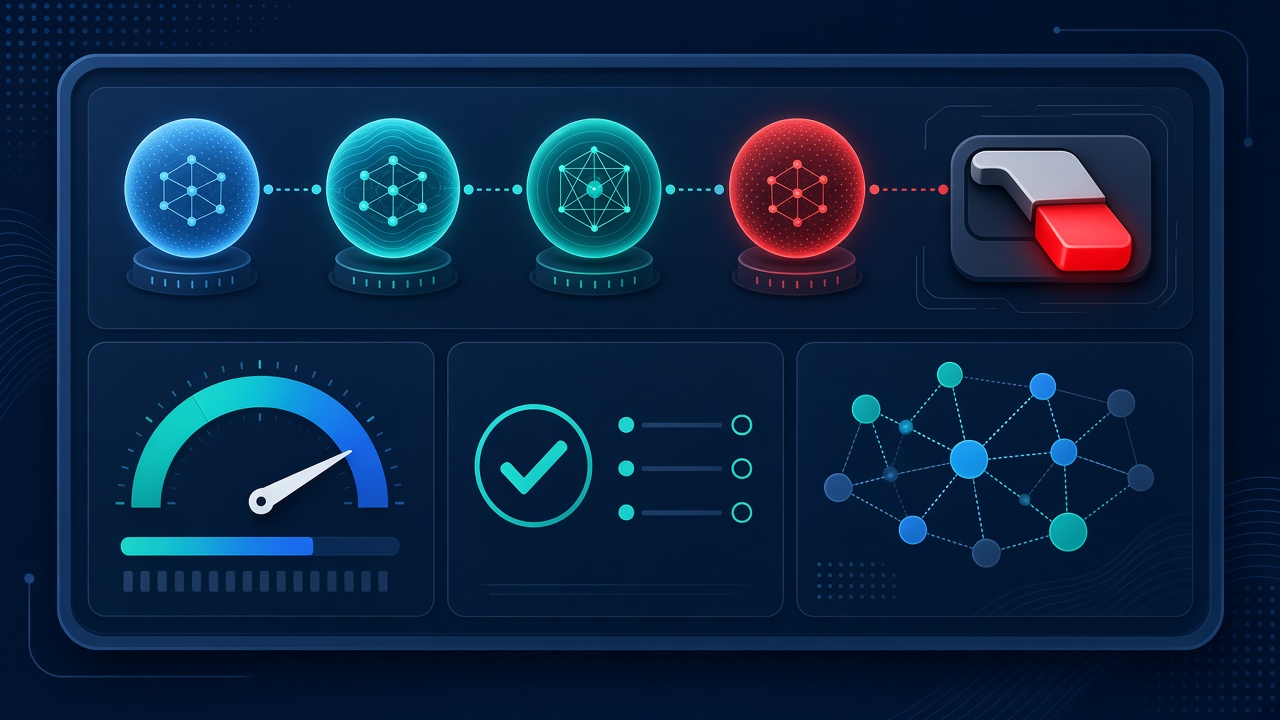
Salesforce announced Agent Evals, API Evals and advanced cost controls for Agent Fabric on 27 October 2026. The goal: catch AI agents that fail silently or overspend, and stop them automatically, including with an Agent Kill Switch. Here is what launched, what’s available today, and what it means for teams running agents and automations.
What did Salesforce announce?
According to Salesforce’s announcement, Agent Fabric is its AI control plane for managing and governing agents across platforms, now handling over 1.2 billion requests a day. The update adds continuous evaluation and automated intervention to that control plane.
| Feature | What it does | Availability |
|---|---|---|
| Agent Evals | Generates tests before deployment; evaluates agents, LLMs and MCP servers in production against quality thresholds | Beta Nov 2026, GA Jan 2027 |
| API Evals | Generates functional and performance tests from API specs to catch breaking changes | Beta Nov 2026, GA Jan 2027 |
| Agent Kill Switch | Pulls an agent offline | GA now; triggered version GA Jan 2027 |
| FinOps Dashboard, Model Wallet | One view of AI spend, hard budget limits | GA now |
| Cost Optimization Policies | Semantic caching, payload compression, response trimming | GA now |
| Custom Agent Scanner | Discovers agents, models, MCP servers and APIs beyond built-in support | Beta now, GA Jan 2027 |
| Open Policies for Federated API Gateways | One policy across Azure, Apigee and Kong gateways | GA now |
Why agents need evals and kill switches
Salesforce’s argument is simple: agents can “fail silently, delivering wrong answers and racking up costs before anyone notices.” It cites research that fewer than half of organizations with agents evaluate them on live traffic, and says 96% of enterprises run agents on more than one platform.
Salesforce’s example: a retailer moves its order-support agent to a cheaper model. Scheduled Agent Evals detect wrong answers about delayed orders, flag the issue and ask for approval to quarantine the agent. The team fixes the instructions, reruns the evaluation and returns the agent to production.
“Enterprises can only scale agents as fast as they can keep them accurate and on budget,” said Andrew Comstock, SVP and GM of MuleSoft and Agent Fabric.
The cost-control angle
Hard spending limits are the most immediately useful part: the FinOps Dashboard and Model Wallet stop requests before costs exceed budget. Salesforce says Cost Optimization Policies cut token usage by up to 75%, but only “based on test scenarios”, so treat that as a ceiling rather than a promise.
What it means for automation teams
You don’t need Agent Fabric to apply the pattern. For agents built in n8n, Make or Zapier:
- Write tests before you ship. Keep a small set of real inputs and expected outputs, and rerun them whenever you change the model or prompt.
- Evaluate on live traffic. Log a sample of agent runs and review them weekly.
- Cap spend. Set hard limits with your model provider and alert on daily spikes.
- Build a kill switch. A single flag (in a database or env variable) that every agent workflow checks before acting.
- Watch your APIs. When an API changes, agents break first; add error handling and alerts.
Check exported n8n workflows for missing error handling and exposed keys with our free n8n Workflow Auditor. Model the cost of running agents on n8n, Zapier or Make with the n8n Cost & Hosting Planner, and compare AI tool prices in the AI SaaS Pricing Comparison. Related: IBM Integration Intelligence Hub and Zapier vs Make vs n8n AI agents.
What we don’t know yet
The announcement doesn’t give pricing for Agent Evals or the cost controls. Salesforce notes that some features are unreleased and that customers should base purchase decisions on released features.
Frequently asked questions
What did Salesforce announce for Agent Fabric on 27 October 2026?
Salesforce announced Agent Evals, API Evals and advanced cost controls for Agent Fabric, its AI control plane for managing and governing agents across platforms. It also announced a Custom Agent Scanner and Open Policies for federated API gateways from Azure, Apigee and Kong.
What are Agent Evals?
Agent Evals automatically generate tests before deployment, then evaluate agents, LLMs and MCP servers in production against defined quality thresholds. When results fall short, they trigger predefined interventions, including the Agent Kill Switch, with approval where the team’s policy requires it.
When will Agent Evals be available?
Salesforce says Agent Evals and API Evals enter beta in November 2026 and become generally available in January 2027. The Agent Kill Switch, FinOps Dashboard, Model Wallet and Cost Optimization Policies are generally available now.
How do the cost controls work?
The FinOps Dashboard and Model Wallet give budget owners one view of AI spending and hard limits that stop requests before costs exceed budget. Cost Optimization Policies use semantic caching, payload compression and response trimming; Salesforce says they cut token usage by up to 75% in test scenarios.
Does Agent Fabric only govern Salesforce agents?
No. Salesforce describes Agent Fabric as a control plane for agents across platforms, and the new Custom Agent Scanner extends discovery to internal environments, systems behind firewalls and third-party platforms.
Sources
Salesforce: Salesforce Expands Agent Fabric to Automatically Stop Runaway Costs and AI Agent Failures (27 October 2026). Quotes, figures and availability come from that announcement; we haven’t tested the features.
