

Disclosure: some links in this article are affiliate links. If you buy through them, Sophrai may earn a commission at no extra cost to you. It never changes our rankings. Read our affiliate disclosure.
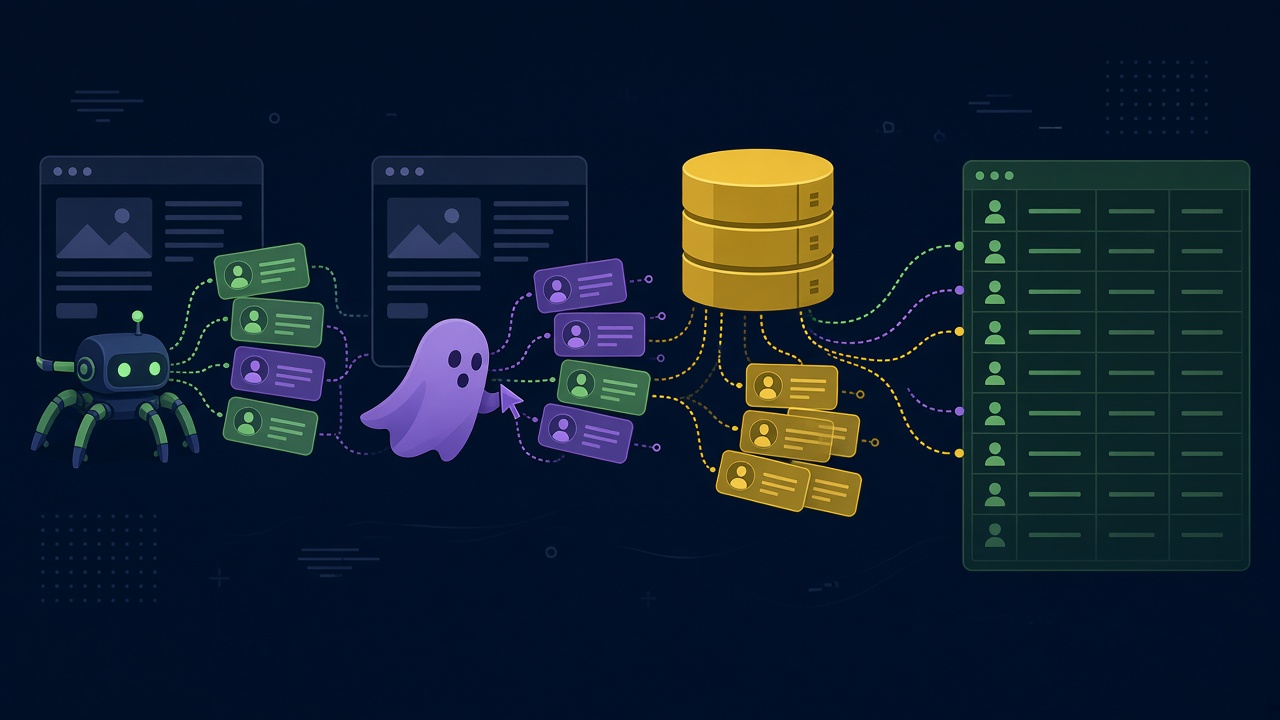
Short answer: use Apollo if you want verified B2B emails and phone numbers from a ready database. Use PhantomBuster if you want no-code automations that pull leads from LinkedIn, Sales Navigator and similar sources. Use Apify if you need to scrape almost any website (Google Maps, directories, marketplaces) at scale, with full control over cost. Prices come from the official pricing pages on 27 October 2026.
Apify vs PhantomBuster vs Apollo at a glance
| Apify | PhantomBuster | Apollo | |
|---|---|---|---|
| What it is | Web-scraping and automation platform (Actors) | Ready-made lead automations (“Phantoms”) | B2B contact database + outreach |
| Data source | Any public website you scrape | LinkedIn, Sales Navigator, other sites + enrichment | Apollo’s own database |
| Free plan | $5 of usage every month | 14-day trial (Free tier: 50 email credits, 10-row exports) | Free: 900 credits/year |
| Entry paid plan | Starter: $19/mo prepaid usage + pay as you go | Start: $56/mo (annual), 20 h execution, 500 email credits | Basic: $49/seat/mo (annual), 30,000 credits/seat/yr |
| Mid plan | Scale: $199/mo + usage | Grow: $128/mo (annual), 80 h, 2,500 email credits | Professional: $79/seat/mo (annual) |
| Top self-serve plan | Business: $999/mo + usage | Scale: $352/mo (annual), 300 h, 10,000 email credits | Organization: $119/seat/mo (annual) |
| Billing unit | Compute units ($0.13–0.20/CU), proxies, Actor fees | Execution hours + email/AI credits | Seats + credits |
| Users | Per account | Unlimited users | Per seat |
| n8n | Official integration | Built-in n8n node | API via HTTP Request |
Sources: Apify pricing, PhantomBuster pricing, Apollo pricing.
How each tool finds leads
Apify is infrastructure. You run “Actors” (scrapers) from the Apify Store, for example Google Maps, a company directory or a job board, or write your own. You pay for compute, proxies and sometimes a per-result fee to the Actor’s developer. It’s the most flexible and, at volume, often the cheapest per record, but you get raw data you must clean and verify.
PhantomBuster is ready-made automation. You pick a Phantom such as a Sales Navigator search export or a profile scraper, connect your account, and schedule it. Plans limit execution time per month, and email credits handle enrichment. It’s fast to start but tied to the rules and rate limits of the sites it automates.
Apollo is a database. You filter by title, industry, size and location and reveal contacts with credits. There’s no scraping on your side, and the data comes with verification status. You also get sequences and a dialer in the same tool. We compared its credits with Clay in Clay vs Apollo for lead enrichment.
Cost for 1,000 leads a month: a rough guide
Exact costs depend on the scraper, site and enrichment. As a rule of thumb from the official plans:
- Apify: Starter ($19 usage) covers many small scraping jobs; heavy Google Maps or proxy-heavy runs move you toward Scale ($199).
- PhantomBuster: Start ($56/mo annual) gives 20 hours of execution and 500 email credits, so 1,000 enriched emails need Grow (2,500 credits).
- Apollo: one Basic seat ($49/mo annual) includes 30,000 credits a year up front, plenty for 1,000 contacts a month, though phone reveals cost more credits.
Estimate the automation side with our n8n Cost & Hosting Planner, and compare per-seat prices across your sales stack in the AI SaaS Pricing Comparison.
Data quality and compliance
Scraped data (Apify, PhantomBuster) is only as good as the source: expect duplicates, missing emails and stale titles. Verify emails before you send. Apollo provides verification status, but no database is perfect.
Compliance matters more than price. Many sites, including LinkedIn, forbid automated scraping in their terms, and accounts used for automation can be restricted. If you collect personal data about people in the EU, EU data-protection rules (GDPR) apply. Prefer business data, document your lawful basis, honor opt-outs, and get legal advice for your market.
Automating the pipeline with n8n
A practical stack: scrape or search → enrich → verify → push to CRM → start a sequence.
- Trigger an Apify Actor or a PhantomBuster Phantom on a schedule from n8n (Apify n8n docs, n8n PhantomBuster node).
- Enrich missing emails with Apollo’s API.
- Deduplicate and write to Google Sheets or your CRM.
- Send verified leads to your sending tool; see Instantly vs Smartlead.
Before going live, run the workflow export through our free n8n Workflow Auditor to catch hard-coded API tokens and missing error handling.
Pros and cons
Apify
- Pros: scrapes almost anything; huge Actor store; usage pricing scales down to $0; strong API and n8n support.
- Cons: technical; raw data needs cleaning; costs vary by Actor and proxies.
PhantomBuster
- Pros: fastest no-code start for LinkedIn-style workflows; unlimited users; built-in n8n node; AI and email credits included.
- Cons: execution-hour limits; depends on third-party site rules; annual billing for the headline prices.
Apollo
- Pros: verified contacts without scraping; outreach included; generous free plan.
- Cons: per-seat cost grows with team size; credits expire each cycle; database coverage varies by region.
Which should you choose?
| If you need… | Choose |
|---|---|
| Local businesses from Google Maps or directories | Apify |
| LinkedIn / Sales Navigator lists without code | PhantomBuster |
| Verified emails and phones for a defined ICP | Apollo |
| Custom scraping at the lowest cost per record | Apify |
| One tool for data and sequences | Apollo |
See the full landscape in our Sales & Lead Gen Tools hub.
Frequently asked questions
What is the difference between Apify, PhantomBuster and Apollo?
Apify is a general web-scraping and automation platform with thousands of ready-made scrapers (Actors), billed by usage. PhantomBuster runs ready-made automations for LinkedIn, Sales Navigator and other sites, billed by execution time. Apollo is a B2B contact database with built-in outreach, billed per seat with credits.
Which is cheapest for lead scraping?
For small tests, Apify’s free plan includes $5 of monthly usage and Apollo has a free plan with 900 credits a year. PhantomBuster offers a 14-day trial; its Start plan is $56 a month billed annually. At scale, the cheapest depends on whether you need raw scraping (Apify) or verified contacts (Apollo).
Does n8n work with Apify, PhantomBuster and Apollo?
n8n has a built-in PhantomBuster node. Apify documents an official n8n integration. Apollo can be connected through its API with n8n’s HTTP Request node. All three can feed leads into a CRM or Google Sheet from n8n.
Is it legal to scrape leads from websites and LinkedIn?
It depends on the site’s terms, the data and your jurisdiction. Scraping personal data of people in the EU falls under GDPR, and many sites, including LinkedIn, prohibit automated scraping in their terms. Get legal advice for your use case and prefer licensed data sources for personal contact details.
Do unused credits roll over?
Apollo says unused credits expire at the end of each billing cycle. Apify says unused prepaid usage expires at the end of the billing cycle. Check PhantomBuster’s plan page for its current rules.
Sources
Apify pricing, PhantomBuster pricing, Apollo pricing, Apify n8n integration, n8n PhantomBuster node. Checked 27 October 2026; prices in USD before tax. We haven’t benchmarked data quality.
