

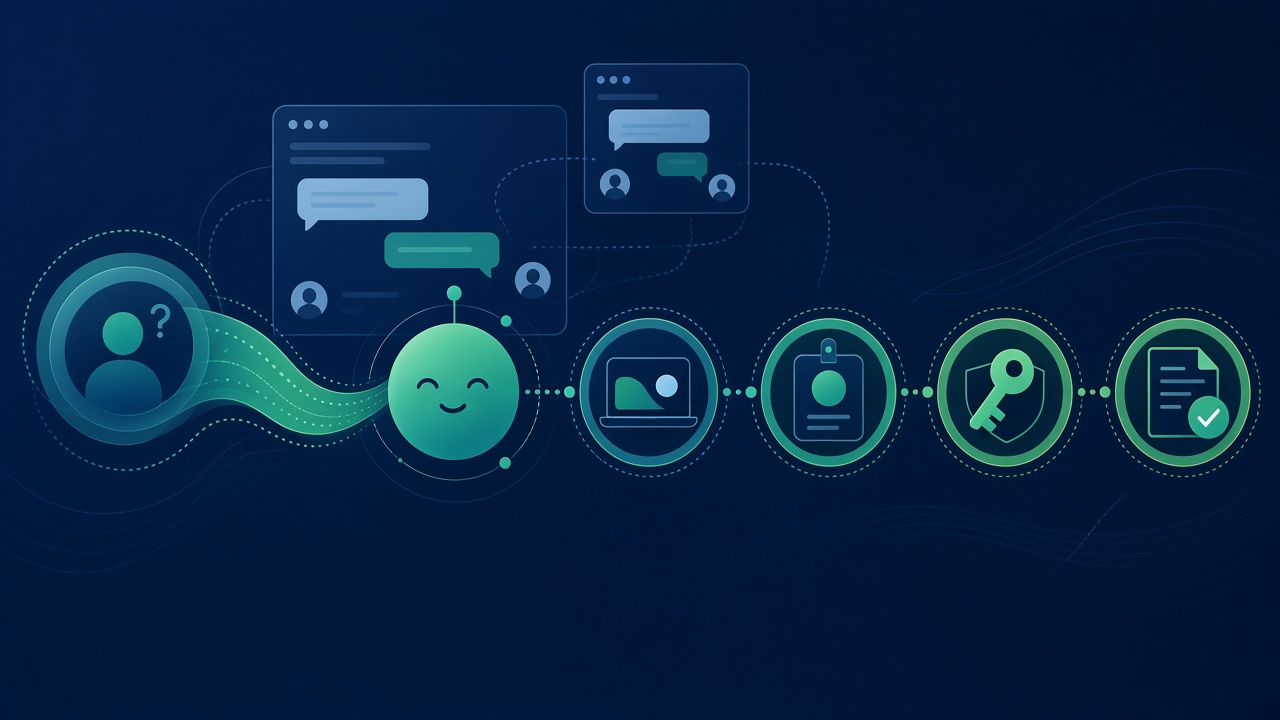
Zendesk introduced Employee Service AI Agents and Advanced Action Flows on 26 October 2026. Together they aim to take internal IT, HR and workplace requests from question to finished outcome: onboarding, offboarding, access approvals, laptops, verification letters and badge access. Here is what launched, the numbers Zendesk shared, and what it means for teams building internal automation.
What did Zendesk announce?
According to Zendesk’s press release, Employee Service AI Agents “understand what employees need and determine how to help,” while Advanced Action Flows give them the skills to act: administrator-built workflows that run tasks in line with company policy.
| Capability | What it does |
|---|---|
| Employee Service AI Agents | Understand employee requests and decide how to help |
| Advanced Action Flows | Admin-built workflows that carry out multi-step tasks across systems |
| Natural-language building | Admins describe the automation; it is created, tested and refined |
| Workspace delivery | Requests in Slack and Microsoft Teams, with work coordinated in back-end systems |
| Availability | Open early access; general availability “in the coming weeks” |
The numbers Zendesk shared
In the first five weeks of early access, Zendesk says 300 customers ran 6 million workflow executions with Advanced Action Flows, saving an estimated 500,000 hours. The footnote matters: the estimate assumes five minutes saved per execution, a benchmark Zendesk calls conservative. Treat it as a vendor estimate, not a measured result.
“AI should do more than answer employees’ questions – it should help get their work done the way they intended to,” said Shashi Upadhyay, President of Product, Engineering, and AI at Zendesk.
Why this matters: from answers to outcomes
Most internal help-desk bots answer questions and then open a ticket. Onboarding a new hire, though, needs hardware, accounts, access and paperwork across several teams and approvals. Zendesk’s pitch is that the agent coordinates the whole chain, while admins keep control through the flows they define.
That is the same pattern we covered in Stripe Treasury for agents and IBM Integration Intelligence Hub: agents act, but inside workflows and permissions humans set.
What it means for automation teams
If you already automate internal processes with n8n, Make or Zapier, this launch is both competition and a blueprint:
- Map your top requests. List the five employee requests that take the most hours (access, devices, letters). These are the best automation candidates whichever tool you use.
- Separate the agent from the action. Let AI classify and gather details; let a deterministic, reviewed workflow do the changes.
- Keep approvals in the loop. Access and offboarding should require a named approver.
- Audit your existing flows. Run exported n8n workflows through our free n8n Workflow Auditor to catch exposed credentials and missing error handling before you connect them to an agent.
- Compare the cost. Our n8n Cost & Hosting Planner estimates run costs on n8n, Zapier and Make, and the AI SaaS Pricing Comparison shows per-seat prices for AI tools your team might add.
What we don’t know yet
Zendesk’s release doesn’t give pricing, a firm GA date or the full list of supported integrations. More detail is on Zendesk’s Employee Service AI Agents page. We’ll update this article when GA lands.
Frequently asked questions
What did Zendesk announce on 26 October 2026?
Zendesk introduced Employee Service AI Agents and Advanced Action Flows. The agents understand what an employee needs; Advanced Action Flows are administrator-built workflows that carry out the tasks, such as access approvals, laptop lifecycle management, employment verification letters and badge access.
Are Zendesk Employee Service AI Agents available now?
They are available through Zendesk’s open early access program. Zendesk says general availability is expected in the coming weeks.
How are Advanced Action Flows built?
Zendesk says IT admins can create, test and refine automations by describing what they need in natural language, and that the flows help identify and configure the integrations and generate the business logic to connect systems.
Where can employees use the agents?
When the agents are connected to Advanced Action Flows, employees can make requests in tools they already use, such as Slack and Microsoft Teams.
How much time do Advanced Action Flows save?
Zendesk says 300 early-access customers ran 6 million workflow executions in five weeks, which it estimates saved 500,000 hours, based on a benchmark of five minutes saved per execution. That is Zendesk’s estimate, not an independent measurement.
Sources
Zendesk press release: Employee Service AI Agents and Advanced Action Flows (26 October 2026). Quotes and figures come from that release; we haven’t tested the product.
